Two things happened to animal control this month. Dozens of cities ran dog-management campaigns at once — leash-law fines, registration checks, stray sweeps across whole districts. And in the middle of those sweeps, the usual videos made the rounds: a loose dog had bitten someone, officers responded, and the incident ended with a shot fired on a residential street, in front of people holding phones. The public asks for both safety and restraint, usually in the same comment thread. Most toolkits on the truck can only deliver one or the other.
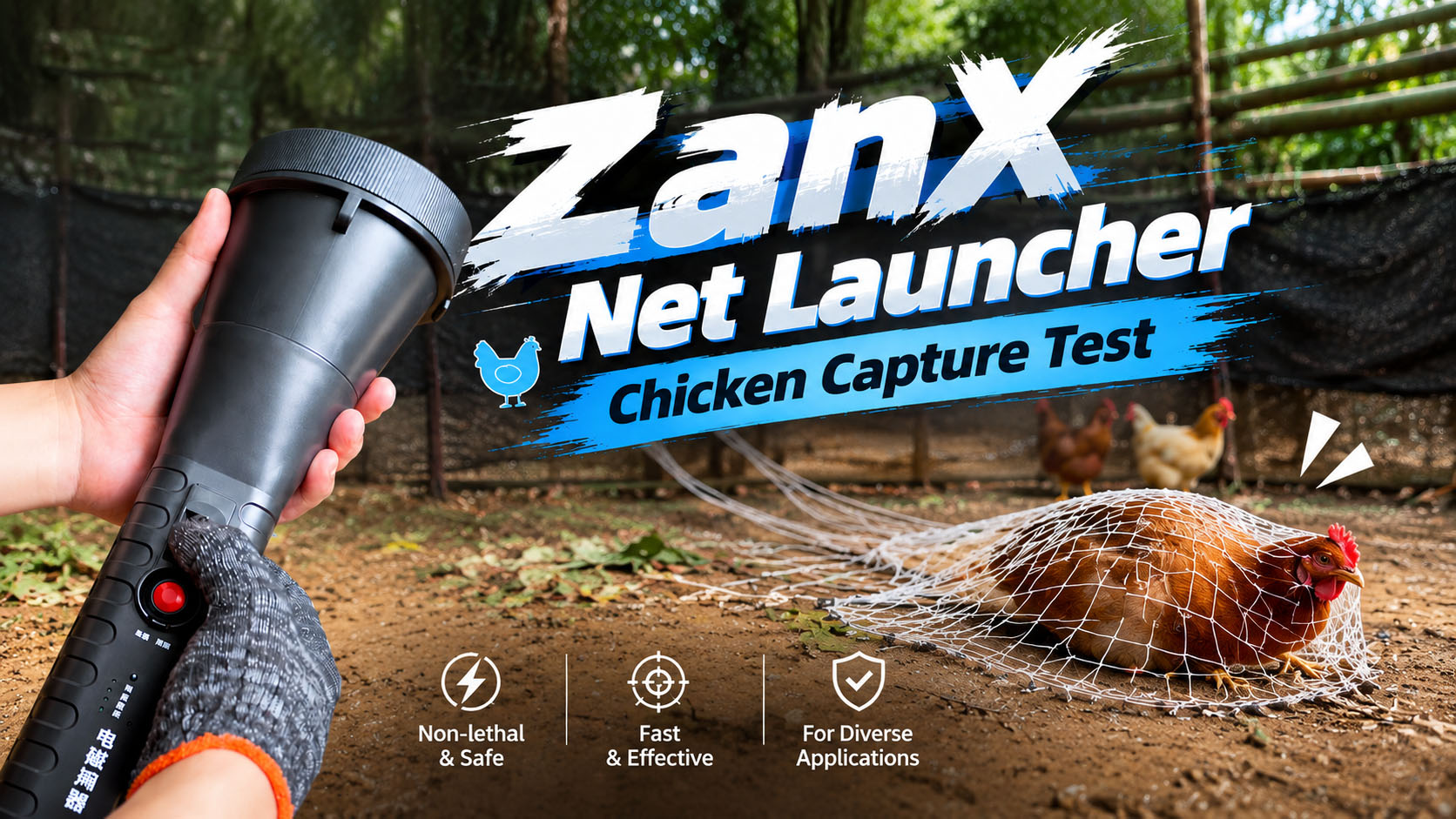
Filmed in one take: the live chicken capture test behind this article.
1. The Toolkit on the Truck, and Where Each Tool Breaks
The catch pole is standard issue because it is cheap and needs no permits. It also works at arm's length — the exact distance a frightened dog can cross in a single stride. Handlers take bites doing this work. The dog takes a bruised throat and a struggle it will remember. Done properly it needs two trained people; most calls send one.
The tranquilizer dart looks gentle and isn't quick. Dose is estimated by weight, onset takes minutes rather than seconds, and a half-sedated animal can still run — into traffic, into a drain, out of sight. Add controlled-substance custody, veterinary oversight, and the paperwork that follows every dart, and most field teams reserve it for cases that truly need it.
Lethal force ends the incident fast and creates a worse one. Discharging a lethal device on a residential street is restricted nearly everywhere. And once the footage exists, the department owns that clip for a very long time, whatever the internal review concludes.
| Method | Distance | Risk to animal | Risk to officer | On camera |
|---|---|---|---|---|
| Catch pole | Arm's length | Neck strain, struggling | Bite exposure | Tense, but defensible |
| Tranquilizer dart | 5–20 m | Dose error, stress, flight | Approach during onset | Shows a dart hit, then a chase |
| Lethal options | Long | Lethal | Discharge rules | Reads badly even when justified |
| Net launcher | 5–10 m | Fabric wrap, no impact point | Minimal | Clean wrap, animal guided to a crate |
2. What Non-Contact Capture Actually Looks Like
ZANX launchers use an electromagnetic system: energized coils accelerate the net's four weighted pull heads to 32 m/s. No propellant, no combustion. At 10 meters the net — 2.25 × 2.25 meters square — opens fully in 0.4 seconds and wraps the animal in fabric instead of striking it. There is no recoil to spoil the aim and no bang to send the animal (or the neighborhood) into a panic; the launch measures 65–75 dB, about a slammed car door.
After the wrap, handlers approach on their own schedule. The animal can be guided into a crate, lifted by the net's edges, and handed to a shelter without anyone grabbing a collar or a limb. The net rinses, dries, and repacks for the next call.
3. The Camera Changed the Job
Every restraint now has witnesses: bodycams, doorbell cameras, bystanders. A capture that ends with an animal walking into a crate is defensible on video. A cull is not — and departments have learned that the internal finding matters less than the clip.
Intact capture has downstream value too. Rabies observation requires a living animal. Bite quarantines need one. Ownership disputes get resolved because the animal exists to be examined. More cities are writing “capture, don't cull” into policy, and the teams we talk to cite this first — before they mention the hardware.
4. Where the Tool Earns Its Place
Stray sweeps in dense housing. Quiet launches, no crowd panic, and battery for 50-plus launches per charge — enough to work a full afternoon without a recharge. A standard 12.6 V battery tops up over TYPE-C from a vehicle.
The aggressive-dog call. The one where a dog is actively charging. Stand-off distance matters most here, and the dual-shot configuration puts a second net in the air within two seconds if the first one misses a moving target.
Wildlife in town. Boars in parking garages, deer in schoolyards, reptiles in garden ponds — recurring calls in suburban districts everywhere. A 5–10 meter wrap keeps the crowd, the officer, and the animal separated while a plan is made.
Shelters, zoos and veterinary teams. Moving an animal between enclosures without sedation is faster, cheaper and kinder — and avoids the drug recovery time.
5. One Budget Line, Several Mandates
Animal control is rarely a department's only job. The same launcher covers subject restraint and public-order response, which is why it makes sense to budget one per vehicle pool rather than one per unit. Design life is rated at four years or 1,000 launches, and the closed-loop electromagnetic system holds muzzle energy consistent from the first launch to the last — a dart's effect, by contrast, is never quite the same twice.
6. Picking the Configuration
The single-shot JC-NG-03 suits teams whose animal calls are occasional: light enough for one-hand carry, stores in a patrol-vehicle door pocket. The dual-shot JC-DNG-06 (1.6 kg) suits regular field work: two nets in under two seconds, bolt-action rear reload in under two more. Both models are rated from −10°C to 50°C — no pressure loss in cold weather, which is where gas-powered devices fall off.
One honest caveat: a net does not replace chemical immobilization for very large or genuinely dangerous wildlife — that stays with trained veterinarians. The launcher covers the everyday ninety percent, which is exactly where the current toolkit struggles.
7. Before the First Shift
Stay inside the 5–10 meter window: closer defeats the purpose of stand-off, farther weakens the wrap. Lead the animal — fire where it will be, not where it stands. Aim low on four-legged targets so the net gathers legs and body in one pass. Approach from behind after the wrap, crate promptly, and log every deployment; that log doubles as your audit trail when a call ends up on the evening news. Teams that train it like any other use-of-force tool — a short drill, practice nets, a signed record — get fluent in an afternoon.
Full specifications, safety notes and care instructions are in the user manuals, and our team runs deployment programs for animal control agencies of any size.